The Essential Guide to Visiting Belgium (2026)
Let me be honest with you: Belgium is one of the most underrated countries in Europe, and people keep sleeping on it. It’s tiny, it’s easy to get around, and somehow it’s packed with stunning medieval cities, food that’ll ruin you for home cooking, and enough beer varieties to keep you busy for a lifetime. People fly to Paris or Amsterdam and skip Belgium entirely, which is a genuine mistake.
Here’s everything you need to know before you go.
Where is Belgium?
Belgium sits smack in the middle of Western Europe, bordered by France, the Netherlands, Germany, and Luxembourg. That central location is honestly one of its best features — Brussels is about 2 hours from Paris by train, 2 hours from Amsterdam, and less than 2 hours from London via Eurostar. You can pair Belgium with basically any Western European trip without it feeling like a detour.
Two airports to know: Brussels Airport (BRU/Zaventem) is the main one, with easy train connections to the city. Charleroi Airport (CRL) is farther out but popular with budget airlines — there are direct buses to Brussels-Midi station if you land there. Just factor in the extra travel time.
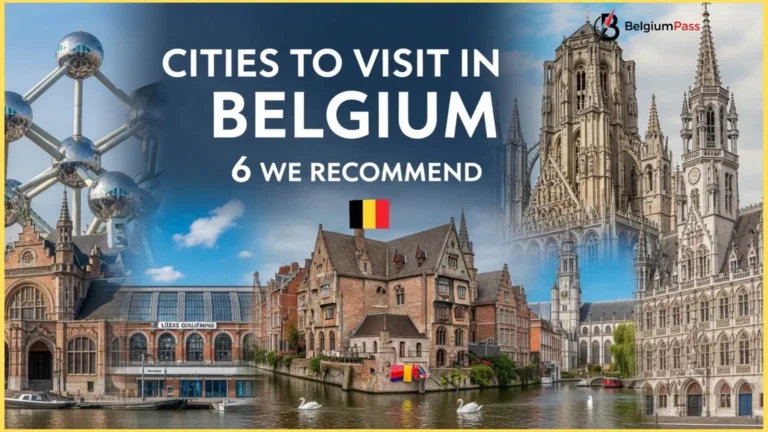
Best cities (in order of “you must go”)
Brussels — the weird, wonderful capital
Brussels doesn’t always get the love it deserves, which is a crime. Yes, it’s also the EU headquarters, and there are a lot of suited people walking around looking important. But underneath that, it’s a city with stunning Gothic architecture, chocolate shops on every corner, comic book murals painted on random building walls (yes, really — Tintin is literally on the side of someone’s apartment), and some of the best food in Europe.
The must-dos:
Grand Place — UNESCO World Heritage Site and one of the most gorgeous squares you’ll ever stand in. Go at night when it’s lit up and try not to audibly gasp.
Royal Gallery of Saint Hubert — the world’s oldest shopping arcade, lined with chocolatiers and fancy cafés.
Atomium — a giant 1958 World’s Fair structure that looks like a molecule designed by someone who loved sci-fi movies. Very Brussels energy.
Comic Book Route — murals of Tintin, Lucky Luke, and friends on walls around the city. Fun to find them.
Food mission in Brussels: street waffle, proper frituur fries with mayonnaise, chocolate tasting, and at least one evening in a classic Belgian beer café. These are not optional.
Bruges — the city that looks fake but isn’t
If you’ve ever seen a postcard of Belgium, it was Bruges. Medieval canals, cobblestone streets, a 13th-century belfry tower you can climb — the whole place looks like a film set. The slightly annoying thing is it’s become very popular (understandably), so midday in summer feels like navigating a very photogenic theme park.
What to do:
Canal boat tour (short, beautiful, worth it).
Climb the Belfry (366 steps, incredible views from the top).
Wander Market Square.
Hit the chocolate shops — there are a lot, pace yourself.
Day trip from Brussels or stay overnight? The train takes about 53 minutes, so day trips are totally doable. But staying overnight gives you those calm evenings and early morning hours before the crowds arrive. If photos matter to you, the extra night is 100% worth it.
Antwerp — the cool one
Antwerp is Belgium’s second city and, honestly, the most stylish. Fashion scene, historic diamond district, great nightlife, and the kind of “real city” energy that Bruges lacks.
Don’t miss:
Antwerp Central Station — it’s a train station that looks like a cathedral. Genuinely one of the most beautiful in the world. You’ll feel weird just buying a ticket there.
MAS Museum — modern, interesting, great rooftop views over the port.
Diamond Quarter — 80% of the world’s rough diamonds pass through Antwerp. Wild fact.
Cathedral of Our Lady — Gothic architecture + Rubens paintings inside.
Shopping + fashion streets — for looking or buying, no judgment.
Ghent — the local favourite (and slightly the best)
Ghent is what you get when you want Bruges vibes but without the tourist crowds — and a lot of people end up liking it most. Student city energy, incredible medieval sights, great food and nightlife, and way more “real life Belgium” feeling.
See:
Gravensteen Castle — an imposing medieval fortress right in the city centre.
Saint Bavo’s Cathedralis home to the Van Eyck Altarpiece, one of the most important paintings in Western art history.
Graslei waterfront — medieval guild houses along the canal, stunning at sunset.
Stay for dinner + a late drink. Ghent after dark is genuinely great.
Beyond the cities — stuff worth leaving town for
Waterloo Battlefield — 20 minutes from Brussels, where Napoleon famously had his worst day ever in 1815. The Lion’s Mound gives you a full overview of the field.
The Ardennes, southeastern Belgium, is a completely different scenery: forests, river valleys, medieval castles, hiking trails, and beers brewed by monks. Dinant (dramatic citadel above the Meuse River) makes a great base.
Manneken Pis — a tiny bronze statue of a peeing boy that somehow became one of Brussels’ most famous landmarks. It’s smaller than you think. Still fun. Very Belgium.
Ypres (Ieper) — a moving WWI memorial town. The daily Last Post ceremony at the Menin Gate is genuinely powerful if history matters to you.
The food situation (this is important)
Belgian food culture is serious, and people don’t talk about it enough compared to France or Italy. Here’s what you must eat:
Belgian waffles — two styles: Brussels waffles (light, rectangular, crispy) and Liège waffles (denser, sweeter, caramelized sugar). Both are amazing. Eat both. Don’t choose.
Belgian fries — not French fries (please don’t call them that). Thick-cut, double-fried, served in a paper cone with mayo. Find a real frituur, not a tourist stand.
Belgian chocolate — Neuhaus, Leonidas, Godiva, all started here. Skip the airport chocolate and find a local chocolatier for fresh pralines and truffles.
Moules-frites — mussels + fries, classic combo, especially good in Brussels.
Belgian beer — 1,500+ varieties. Trappist ales are brewed by actual monks, sour lambic beers, and rich abbey ales. A proper beer café will have 100+ on the menu. Take your time. This is research.
Speculoos — a spiced biscuit that Belgium quietly gave to the world as Lotus Biscoff. You’ve been eating Belgian food this whole time.
Best time to go
Honestly, May–June and September are the sweet spots — decent weather, manageable crowds, better hotel prices.
Getting around (simpler than you think)
The train network is your best friend for city-hopping. Brussels → Bruges → Ghent → Antwerp → Leuven are all well-connected, cheap, and reliable. Walk or use local trams once you arrive — city centres are compact.
For the Ardennes and countryside, a rental car makes much more sense than figuring out rural bus timetables.
Belgium is also surprisingly cycling-friendly — renting a bike in Bruges or Ghent for a few hours is genuinely one of the most enjoyable ways to explore. Very local, very easy.
If you’re doing multiple train hops, SNCB’s 10-journey card covers 10 single journeys between Belgian stations and is valid for a year — good value if you’re moving around a lot.
Quick tips before you go
Three languages depending on region: Dutch in Flanders (north), French in Wallonia (south), and German in a small eastern pocket. Brussels is officially bilingual. Tourism staff almost always speak English well.
Currency: Euro. Simple.
Tipping: Not obligatory, but rounding up or leaving 5–10% at sit-down restaurants is appreciated and won’t be expected.
Chocolate shelf life: Fresh Belgian pralines from a proper chocolatier expire in days/weeks — they’re not shelf-stable candy bars. Buy them close to when you’ll eat or gift them.
Safety: Very safe. Standard city common sense (watch your bag in crowded tourist spots), nothing to stress about.
Sample 3-day itinerary
Day 1 — Brussels
- Morning: Grand Place + Royal Gallery of Saint Hubert.
- Afternoon: Atomium (book ahead) + Comic Book Route wander.
- Evening: Belgian beer café + fries dinner.
Day 2 — Bruges
- Take the 53-min train, and a canal boat tour in the morning.
- Afternoon: Belfry climb + Market Square + chocolate shops.
- Evening: Either head back to Brussels or stay overnight for the quiet morning advantage.
Day 3 — Ghent or Antwerp
- Ghent: Gravensteen + Saint Bavo’s + Graslei evening walk.
- Antwerp: Central Station + MAS Museum + Diamond Quarter + fashion streets.
- Both are ~30 minutes from Brussels by train, so you can easily get back for a late flight.
So why Belgium, really?
Belgium doesn’t shout about itself. It doesn’t do massive marketing campaigns or try hard to be cool. It just quietly has incredible medieval cities, world-class food and beer, easy train connections, and a laid-back culture that rewards people who actually show up.
The food is serious. History is everywhere. The cities are walkable. The trains are reliable. And because everyone keeps flying past it to go to Paris or Amsterdam, you get all of this without the insane crowds those cities deal with in peak season.
If Belgium has been sitting on your “maybe someday” list, move it to the top. You’ll wonder why it took you so long.